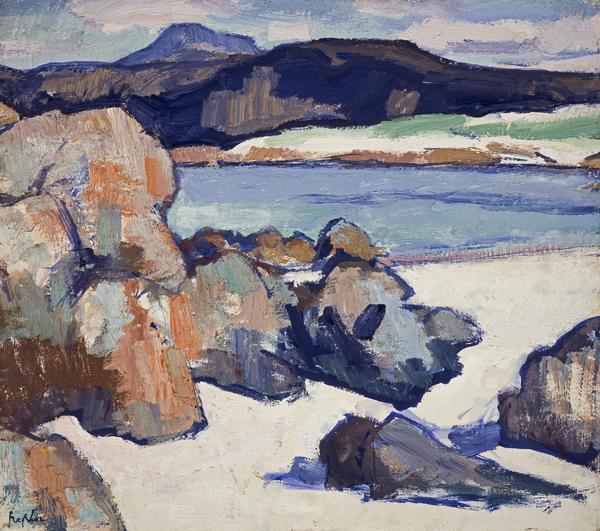
William McTaggart
The Storm
1890"Being part-Cornish, the sea is in my genes, so I love The Storm, set in Carradale, Argyll, which I remember visiting as a teenager with my school chums. I've never forgotten it because Andrew Keir, the great Scottish actor who we all fancied, was on the bus on his way to visit the writer Naomi Mitchison. I look at this painting and memories flood back -- Andrew Keir, meeting boys, fishing for mackerel. I can hear the wind; I can smell the ozone. Of course, being an actress I love the drama of it; it's swirling with energy. Although I'm not a Scottish Nationalist, I love my country and I'm glad I've chosen a Scottish artist."
Una McLean, actress
"William McTaggart was an outstanding Scottish artist and a pioneer of Impressionism. For me, Spring and The Storm epitomise both the joys and the challenges of the Scottish people: Spring, with its bright awakening of nature and feeling of hope for the future, and The Storm, with its depiction of the indomitable spirit of the fishing communities that I know so well."
Alex Salmond, First Minister
"McTaggart is not only a favourite painter but I feel he was a painter of great vision, ahead of his time. This painting is so abstract and yet so real, a mixture of Impressionist and Expressionist techniques, even though Expressionism wasn't even invented in 1890! The mass of the landscape and sky look threatening, but it actually lifts the spirit because of the intensity of light. I'm sure McTaggart was trying to emphasise a sense of hope by the use of strong light."
Dr. John Lowrie Morrison, artist
- Glossary (1 term)
- Open
Philanthropy
A concern for human welfare, often evident in activities such as charitable aid and donations.
- Glossary (3 terms)
- Open
Impressionism
An influential style of painting that originated in France in the 1870s with artists such as Claude Monet, Pierre-August Renoir and Alfred Sisley. They were interested in capturing the changing effects of light, frequently exploring this through landscape scenes painted in the open air.
Royal Scottish Academy
The Royal Scottish Academy (RSA) was formed in Edinburgh in 1826 by Scottish artists who felt alienated by what they perceived as the elitism of the Royal Institution and its management of contemporary art exhibitions. In 1835, the RSA secured exhibition rights in the Royal Institution building, which had been erected on The Mound by the Board of Manufactures in 1826. The RSA and the Board frequently argued over responsibilities for advanced art education. From 1859, the RSA shared the premises of the new National Gallery of Scotland under the Board?s custody. In 1910, after transferring most of its art collections to the Gallery, the RSA gained exclusive tenancy of the former Royal Institution building, where it continues to hold large-scale annual exhibitions.
Trustees' Academy
The Trustees? Academy was founded in Edinburgh in 1760 by the Board of Trustees for the Improvement of Fisheries and Manufactures in Scotland. This was the earliest publicly funded art school in Britain, but during the early years it was essentially an elementary drawing school dedicated to applied design. The students included practical craftsmen as well as fine artists. The school gradually developed more facilities for advanced fine art education, including a plaster cast collection. In 1826, it relocated to a new building on The Mound, which was erected by the Board. The Trustees? Academy was reformed in 1858, using the well established government Schools of Design in London as its model, and was the direct ancestor of Edinburgh College of Art, established in 1907.
- Credits Presented by Mrs Andrew Carnegie 1935
- Medium Oil on canvas
- Size 122.00 x 183.00 cm (Framed: 168.50 x 230.00 x 17.50 cm)